Tintinalli Emergency Medicine 8th Edition Pdf Download
| Shock | |
|---|---|
 | |
| A not-pneumatic anti-stupor garment (NASG) | |
| Specialty | Critical care medicine |
| Symptoms | Initial: Weakness, fast heart rate, fast breathing, sweating, anxiety, increased thirst[1] Later: Confusion, unconsciousness, cardiac arrest[1] |
| Types | Low volume, cardiogenic, obstructive, distributive[2] |
| Causes | Low volume: Severe haemorrhage, airsickness, diarrhea, dehydration, or pancreatitis[i] Cardiogenic: astringent eye assail (especially of the left or correct ventricles), severe eye failure, cardiac contusion[1] Obstructive: Cardiac tamponade, tension pneumothorax[i] Distributive: Sepsis, spinal cord injury, certain overdoses[1] |
| Diagnostic method | Based on symptoms, physical exam, laboratory tests[2] |
| Handling | Based on the underlying cause[2] |
| Medication | Intravenous fluid, vasopressors[two] |
| Prognosis | Risk of death 20 to 50%[three] |
| Frequency | 1.2 million per year (US)[three] |
Shock is the state of insufficient blood menstruum to the tissues of the body as a result of bug with the circulatory system.[1] [2] Initial symptoms of shock may include weakness, fast middle rate, fast breathing, sweating, feet, and increased thirst.[one] This may exist followed by defoliation, unconsciousness, or cardiac arrest, every bit complications worsen.[ane]
Daze is divided into four main types based on the underlying cause: depression book, cardiogenic, obstructive, and distributive shock.[2] Depression book daze, also known as hypovolemic daze, may be from bleeding, diarrhea, or vomiting.[1] Cardiogenic shock may be due to a heart attack or cardiac contusion.[1] Obstructive shock may be due to cardiac tamponade or a tension pneumothorax.[1] Distributive shock may be due to sepsis, anaphylaxis, injury to the upper spinal cord, or certain overdoses.[one] [four]
The diagnosis is more often than not based on a combination of symptoms, physical examination, and laboratory tests.[2] A decreased pulse pressure (systolic blood force per unit area minus diastolic blood pressure) or a fast middle rate raises concerns.[1] The heart rate divided by systolic blood pressure, known as the daze index (SI), of greater than 0.8 supports the diagnosis more than low blood force per unit area or a fast center rate in isolation.[5] [6]
Treatment of stupor is based on the likely underlying crusade.[2] An open airway and sufficient breathing should be established.[ii] Any ongoing haemorrhage should be stopped, which may require surgery or embolization.[2] Intravenous fluid, such as Ringer'due south lactate or packed red claret cells, is often given.[2] Efforts to maintain a normal body temperature are besides important.[two] Vasopressors may be useful in sure cases.[2] Shock is both common and has a loftier chance of death.[3] In the United States about 1.two million people present to the emergency room each year with shock and their risk of death is between 20 and 50%.[three]
Signs and symptoms [edit]
The presentation of shock is variable, with some people having just minimal symptoms such as confusion and weakness.[seven] While the full general signs for all types of stupor are depression blood pressure, decreased urine output, and confusion, these may not always be present.[7] While a fast eye rate is common, those on β-blockers, those who are athletic, and in 30% of cases of those with shock due to intra intestinal bleeding may have a normal or wearisome heart rate.[8] Specific subtypes of shock may have additional symptoms.
Dry mucous membrane, reduced skin turgor, prolonged capillary refill time, weak peripheral pulses and cold extremities can be early on signs of stupor.[ix]
Low volume [edit]
Hypovolemic shock is the most mutual type of shock and is caused past insufficient circulating volume.[7] The most common cause of hypovolemic stupor is hemorrhage (internal or external); however, vomiting and diarrhea are more common causes in children.[ten] Other causes include burns, too as excess urine loss due to diabetic ketoacidosis and diabetes insipidus.[10]
| Class | Blood loss (liters) | Response | Handling |
|---|---|---|---|
| I | <fifteen% (0.75 l) | min. fast heart rate, normal claret pressure | minimal |
| Two | fifteen–thirty% (0.75–1.5 50) | fast heart rate, min. low blood pressure | intravenous fluids |
| Iii | 30–40% (1.5–two l) | very fast heart rate, low blood pressure, confusion | fluids and packed RBCs |
| Four | >40% (>2 l) | disquisitional blood force per unit area and center rate | ambitious interventions |
Signs and symptoms of hypovolemic stupor include:
- A rapid, weak, thready pulse due to decreased blood flow combined with tachycardia
- Cool peel due to vasoconstriction and stimulation of vasoconstriction
- Rapid and shallow breathing due to sympathetic nervous arrangement stimulation and acidosis
- Hypothermia due to decreased perfusion and evaporation of sweat
- Thirst and dry mouth, due to fluid depletion
- Common cold and mottled skin (livedo reticularis), especially extremities, due to insufficient perfusion of the skin
The severity of hemorrhagic shock can exist graded on a 1–4 scale on the physical signs. The shock alphabetize (heart charge per unit divided by systolic blood pressure) is a stronger predictor of the touch of blood loss than eye rate and claret pressure lone.[5] This relationship has not been well established in pregnancy-related bleeding.[12]
Cardiogenic [edit]
Cardiogenic stupor is acquired by the failure of the heart to pump effectively.[7] This can be due to damage to the heart muscle, most frequently from a large myocardial infarction. Other causes of cardiogenic shock include dysrhythmias, cardiomyopathy/myocarditis, congestive heart failure (CHF), myocardial contusion, or valvular centre affliction problems.[x]
Symptoms of cardiogenic shock include:
- Distended jugular veins due to increased jugular venous pressure
- Weak or absent pulse
- Aberrant centre rhythms, often a fast centre charge per unit
- Pulsus paradoxus in case of tamponade
- Reduced blood pressure level
- Shortness of breath, due to pulmonary congestion
Obstructive [edit]
Obstructive stupor is a form of shock associated with concrete obstruction of the great vessels of the systemic or pulmonary apportionment.[thirteen] Several conditions can result in this class of shock.
- Cardiac tamponade[ten] in which fluid in the pericardium prevents inflow of blood into the heart (venous return). Constrictive pericarditis, in which the pericardium shrinks and hardens, is similar in presentation.
- Tension pneumothorax[x] Through increased intrathoracic pressure level, bloodflow to the heart is prevented (venous render).
- Pulmonary embolism is the result of a thromboembolic incident in the blood vessels of the lungs and hinders the render of blood to the heart.
- Aortic stenosis hinders apportionment by obstructing the ventricular outflow tract
- Hypertrophic sub-aortic stenosis is overly thick ventricular muscle that dynamically occludes the ventricular outflow tract.
- Abdominal compartment syndrome defined every bit an increase in intra-abdominal force per unit area to > twenty mmHg with organ dysfunction.[14] Increased intraabdominal pressure level tin be due to sepsis and severe abdominal trauma. This increased pressure level reduced blood flow back to the middle, thereby reducing blood flow to the trunk and resulting in signs and symptoms of shock.[15]
Many of the signs of obstructive shock are similar to cardiogenic shock, withal treatments differ. Symptoms of obstructive shock include:
- Abnormal heart rhythms, frequently a fast center rate.
- Reduced claret pressure.
- Cool, clammy, mottled skin, often due to low blood force per unit area and vasoconstriction.
- Decreased urine output.
Distributive [edit]
| Finding | Value |
|---|---|
| Temperature | <36 °C (96.8 °F) or >38 °C (100.iv °F) |
| Heart rate | >90/min |
| Respiratory charge per unit | >20/min or PaCO2<32 mmHg (4.three kPa) |
| WBC | <4x10⁹/50 (<4000/mm3), >12x109/L (>12,000/mmiii), or ≥10% bands |
Distributive shock is low claret force per unit area due to a dilation of claret vessels within the body.[vii] [17] This can exist acquired by systemic infection (septic daze), a astringent allergic reaction (anaphylaxis), or spinal cord injury (neurogenic shock).
- Septic stupor is the most common crusade of distributive shock.[x] It is caused by an overwhelming systemic infection resulting in vasodilation leading to hypotension. Septic shock can be caused past Gram negative bacteria such every bit (among others) Escherichia coli, Proteus species, Klebsiella pneumoniae which accept an endotoxin on their surface which produces adverse biochemical, immunological and occasionally neurological effects which are harmful to the body, and other Gram-positive cocci, such as pneumococci and streptococci, and certain fungi too as Gram-positive bacterial toxins. Septic shock likewise includes some elements of cardiogenic shock. In 1992, the ACCP/SCCM Consensus Conference Commission divers septic shock: " … sepsis-induced hypotension (systolic blood pressure < 90 mmHg or a reduction of 40 mmHg from baseline) despite acceptable fluid resuscitation along with the presence of perfusion abnormalities that may include, only are not limited to, lactic acidosis, oliguria, or an acute alteration in mental status. Patients who are receiving inotropic or vasopressor agents may have a normalized blood pressure at the fourth dimension that perfusion abnormalities are identified. The pathophysiology behind septic shock is as follows: 1) Systemic leukocyte adhesion to endothelial cells[xviii] 2) Reduced contractility of the heart[18] 3) Activation of the coagulation pathways, resulting in disseminated intravascular coagulation[18] 4). Increased levels of neutrophils[18]
- The main manifestations of septic shock are due to the massive release of histamine which causes intense dilation of the blood vessels. People with septic shock volition as well likely be positive for SIRS criteria. The nearly generally accepted handling for these patients is early recognition of symptoms, and early administration of broad spectrum and organism specific antibiotics.[19]
- Signs of septic shock include:
- Abnormal heart rhythms, frequently a fast heart rate
- Reduced blood pressure
- Decreased urine output
- Contradistinct mental status
- Anaphylactic shock is caused by a severe anaphylactic reaction to an allergen, antigen, drug or strange protein causing the release of histamine which causes widespread vasodilation, leading to hypotension and increased capillary permeability. Signs typically occur afterward exposure to an allergen and may include:

- Peel changes, such as hives, itching, flushing and swelling.
- Wheezing and shortness of breath.
- Abdominal pain, diarrhea, and vomiting.
- Lightheadedness, defoliation, headaches, loss of consciousness.
- Loftier spinal injuries may cause neurogenic shock, which is usually classified equally a subset of distributive shock.[20] The classic symptoms include a boring center rate due to loss of cardiac sympathetic tone and warm skin due to dilation of the peripheral blood vessels.[20] (This term can be dislocated with spinal daze which is a recoverable loss of role of the spinal cord afterward injury and does not refer to the hemodynamic instability.)
Endocrine [edit]
Although not officially classified every bit a subcategory of shock, many endocrinology disturbances in their severe form can result in shock.
- Hypothyroidism (can be considered a form of cardiogenic daze) in people who are critically ill patients, reduces cardiac output and can lead to hypotension and respiratory insufficiency.
- Thyrotoxicosis (cardiogenic shock) may induce a reversible cardiomyopathy.
- Acute adrenal insufficiency (distributive daze) is often the result of discontinuing corticosteroid treatment without tapering the dosage. However, surgery and intercurrent disease in patients on corticosteroid therapy without adjusting the dosage to accommodate for increased requirements may also result in this status.
- Relative adrenal insufficiency (distributive daze) in critically ill patients where present hormone levels are bereft to meet the higher demands
Cause [edit]
| Type | Cause |
|---|---|
| Low volume | Fluid loss such as bleeding or diarrhea |
| Center | Ineffective pumping due to heart damage |
| Obstructive | Blood flow to or from the heart is blocked |
| Distributive | Due to aberrant flow inside the small blood vessels[21] |
Daze is a common end bespeak of many medical conditions.[10] Daze itself is a life-threatening condition as a result of compromised body circulation.[22] It can be divided into four main types based on the underlying cause: hypovolemic, distributive, cardiogenic, and obstructive.[23] A few additional classifications are occasionally used, such as endocrinologic shock.[10]
Pathophysiology [edit]
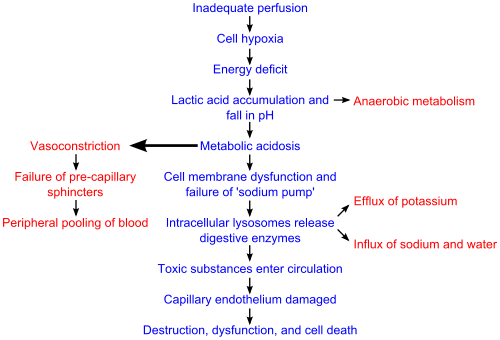
Furnishings of inadequate perfusion on cell function.
At that place are 4 stages of shock. Shock is a complex and continuous status, and there is no sudden transition from one stage to the next.[24] At a cellular level, daze is the process of oxygen demand becoming greater than oxygen supply.[7]
One of the cardinal dangers of daze is that it progresses by a positive feedback loop. Poor blood supply leads to cellular impairment, which results in an inflammatory response to increase blood period to the affected surface area. Normally, this causes the blood supply level to match with tissue demand for nutrients. Even so, if in that location is enough increased need in some areas, it can deprive other areas of sufficient supply, which and so outset enervating more than. This so leads to an always escalating cascade.
As such, shock is a runaway status of homeostatic failure, where the usual corrective mechanisms relating to oxygenation of the body no longer role in a stable way. When it occurs, firsthand handling is critical in order to return an private's metabolism into a stable, self-correcting trajectory. Otherwise the condition can get increasingly hard to right, surprisingly fast, and then progress to a fatal outcome. In the particular instance of anaphylactic shock, progression to death might take just a few minutes.[six]
Initial [edit]
During this stage, the state of hypoperfusion causes hypoxia. Due to the lack of oxygen, the cells perform lactic acrid fermentation. Since oxygen, the terminal electron acceptor in the electron transport concatenation, is non abundant, this slows down entry of pyruvate into the Krebs cycle, resulting in its accumulation. The accumulating pyruvate is converted to lactate by lactate dehydrogenase. The accumulating lactate causes lactic acidosis.
Compensatory [edit]
This stage is characterised by the body employing physiological mechanisms, including neural, hormonal and bio-chemical mechanisms, in an try to reverse the condition. As a event of the acidosis, the person will begin to hyperventilate in order to rid the trunk of carbon dioxide (CO2). CO2 indirectly acts to acidify the claret, and so the body attempts to return to acid–base of operations homeostasis by removing that acidifying amanuensis. The baroreceptors in the arteries detect the hypotension resulting from large amounts of blood being redirected to distant tissues, and crusade the release of epinephrine and norepinephrine. Norepinephrine causes predominately vasoconstriction with a mild increment in heart rate, whereas epinephrine predominately causes an increase in eye rate with a small effect on the vascular tone; the combined issue results in an increase in claret pressure. The renin–angiotensin axis is activated, and arginine vasopressin (anti-diuretic hormone) is released to conserve fluid by reducing its excretion via the renal system. These hormones cause the vasoconstriction of the kidneys, gastrointestinal tract, and other organs to divert blood to the heart, lungs and brain. The lack of blood to the renal arrangement causes the feature low urine production. Nevertheless the furnishings of the renin–angiotensin centrality take time and are of little importance to the firsthand homeostatic mediation of stupor.[ citation needed ]
Progressive/decompensated [edit]
In the absence of successful treatment of the underlying cause, daze volition keep to the progressive stage. During this stage, compensatory mechanisms begin to fail. Due to the decreased perfusion of the cells in the body, sodium ions build up within the intracellular space while potassium ions leak out. Due to lack of oxygen, cellular respiration diminishes and anaerobic metabolism predominates. As anaerobic metabolism continues, a metabolic acidosis, the arteriolar smooth musculus and precapillary sphincters relax such that blood remains in the capillaries.[xviii] Due to this, the hydrostatic pressure will increase and, combined with histamine release, this will lead to leakage of fluid and poly peptide into the surrounding tissues. Every bit this fluid is lost, the blood concentration and viscosity increase, causing sludging of the micro-circulation. The prolonged vasoconstriction will as well cause the vital organs to exist compromised due to reduced perfusion.[eighteen] If the bowel becomes sufficiently ischemic, bacteria may enter the claret stream, resulting in the increased complication of endotoxic shock.[6] [18]
Refractory [edit]
At this stage, the vital organs have failed and the shock can no longer be reversed. Brain impairment and cell expiry are occurring, and decease will occur imminently. One of the primary reasons that shock is irreversible at this signal is that much cellular ATP has been degraded into adenosine in the absenteeism of oxygen as an electron receptor in the mitochondrial matrix. Adenosine easily perfuses out of cellular membranes into extracellular fluid, furthering capillary vasodilation, so is transformed into uric acid. Because cells can only produce adenosine at a rate of well-nigh 2% of the cell's total demand per hour, even restoring oxygen is futile at this point because there is no adenosine to phosphorylate into ATP.[half-dozen]
Diagnosis [edit]
The diagnosis of shock is commonly based on a combination of symptoms, concrete examination, and laboratory tests. Many signs and symptoms are not sensitive or specific for shock, and as such many clinical decision making tools take been adult to identify shock at an early stage.[25] A high caste of suspicion is necessary for the proper diagnosis of shock.
The starting time change seen in shock is increased cardiac output followed by a decrease in mixed venous oxygen saturation (SmvO2) as measured in the pulmonary artery via a pulmonary artery catheter.[26] Key venous oxygen saturation (ScvO2) as measured via a central line correlates well with SmvO2 and are easier to learn. If shock progresses anaerobic metabolism volition begin to occur with an increased blood lactic acid as the upshot. While many laboratory tests are typically performed, there is no test that either makes or excludes the diagnosis. A chest X-ray or emergency department ultrasound may be useful to determine volume status.[vii] [8]
Management [edit]
The best prove exists for the treatment of septic shock in adults. Still, the pathophysiology of shock appears similar in children, and treatment methodologies have been extrapolated to children.[10] Management may include securing the airway via intubation if necessary to decrease the work of breathing and for guarding against respiratory arrest. Oxygen supplementation, intravenous fluids, passive leg raising (not Trendelenburg position) should be started and blood transfusions added if blood loss is severe.[7] It is important to keep the person warm to avoid hypothermia[27] as well as adequately manage pain and anxiety as these can increase oxygen consumption.[vii] Negative impact by daze is reversible if information technology'due south recognized and treated early in time.[22]
Fluids [edit]
Aggressive intravenous fluids are recommended in about types of stupor (eastward.g. 1–ii liter normal saline bolus over 10 minutes or xx ml/kg in a child) which is usually instituted equally the person is being further evaluated.[28] Colloids and crystalloids appear to be like with respect to outcomes.,[29] Balanced crystalloids and normal saline besides announced to be similar in critically ill patients.[thirty] If the person remains in shock later on initial resuscitation, packed blood-red blood cells should be administered to go on the hemoglobin greater than 100 g/fifty.[7]
For those with hemorrhagic shock, the current testify supports limiting the use of fluids for penetrating thorax and abdominal injuries assuasive mild hypotension to persist (known as permissive hypotension).[31] Targets include a mean arterial pressure of sixty mmHg, a systolic blood pressure of lxx–90 mmHg,[7] [32] or until their adequate mentation and peripheral pulses.[32] Hypertonic fluid may as well be an option in this group.[33]
Medications [edit]

Epinephrine auto-injector
Vasopressors may exist used if claret pressure level does not improve with fluids. Common vasopressors used in shock include: norepinephrine, phenylephrine, dopamine, dobutamine.
There is no evidence of substantial do good of one vasopressor over some other;[34] however, using dopamine leads to an increased take a chance of arrhythmia when compared with norepinephrine.[35] Vasopressors take non been establish to improve outcomes when used for hemorrhagic shock from trauma[36] merely may be of use in neurogenic stupor.[xx] Activated protein C (Xigris) while once aggressively promoted for the direction of septic shock has been found not to improve survival and is associated with a number of complications.[37] Activated protein C was withdrawn from the market place in 2011, and clinical trials were discontinued.[37] The utilise of sodium bicarbonate is controversial as information technology has non been shown to improve outcomes.[38] If used at all it should only be considered if the pH is less than 7.0.[38]
People with anaphylactic stupor are usually treated with epinephrine. Antihistamines, such equally benadryl, diphenhydramine and ranitidine are also ordinarily administered. Albuterol, normal saline, and steroids are also unremarkably given.
Mechanical support [edit]
- Intra-aortic balloon pump (IABP) – a device inserted into the aorta that mechanically raises the blood pressure. Employ of Intra-aortic balloon pumps is not recommended in cardiogenic shock.[39]
- Ventricular assistance device (VAD) – A mechanical pump that helps pump blood throughout the body. Commonly used in brusk term cases of refractory primary cardiogenic shock.
- Bogus heart (TAH)
- Extracorporeal membrane oxygenation (ECMO) – an external device that completely replaces the work of the heart.
Treatment goals [edit]
The goal of treatment is to attain a urine output of greater than 0.5 ml/kg/h, a central venous pressure of 8–12 mmHg and a mean arterial pressure of 65–95 mmHg. In trauma the goal is to stop the bleeding which in many cases requires surgical interventions. A skilful urine output indicates that the kidneys are getting plenty blood flow.
Epidemiology [edit]
Septic shock (a class of distributive shock), is the most common class of shock. Shock from blood loss occurs in about ane–ii% of trauma cases.[32] Upward to one-third of people admitted to the intensive intendance unit (ICU) are in circulatory stupor.[40] Of these, cardiogenic shock accounts for approximately xx%, hypovolemic about xx%, and septic shock nigh 60% of cases.[41]
Prognosis [edit]

The prognosis of shock depends on the underlying cause and the nature and extent of concurrent issues. Low book, anaphylactic, and neurogenic shock are readily treatable and respond well to medical therapy. Septic shock, however has a mortality rate between 30% and 80% while cardiogenic shock has a mortality rate between lxx% and xc%.[42]
History [edit]
There is no bear witness of the word daze being used in its modern-day class prior to 1743. However, there is testify that Hippocrates used the give-and-take exemia to signify a state of being "drained of blood".[43] Stupor or "choc" was kickoff described in a trauma victim in the English translation of Henri-François LeDran'due south 1740 text, Traité ou Reflexions Tire'es de la Pratique sur les Playes d'armes à feu (A treatise, or reflections, fatigued from practice on gun-shot wounds.)[44] In this text he describes "choc" as a reaction to the sudden bear upon of a missile. However, the kickoff English language writer to use the word stupor in its modernistic-day connotation was James Latta, in 1795.
Prior to World War I, there were several competing hypotheses behind the pathophysiology of shock. Of the various theories, the most well regarded was a theory penned by George W. Crile who in 1899 suggested in his monograph, "An Experimental Research into Surgical Shock", that shock was quintessentially defined as a state of circulatory collapse (vasodilation) due to excessive nervous stimulation. Other competing theories around the plow of the century included one penned by Malcolm in 1905, in which the assertion was that prolonged vasoconstriction led to the pathophysiological signs and symptoms of shock. In the following Earth War I, research around shock resulted in experiments by Walter B. Cannon of Harvard and William Chiliad. Bayliss of London in 1919 that showed that an increase in permeability of the capillaries in response to trauma or toxins was responsible for many clinical manifestations of shock. In 1972 Hinshaw and Cox suggested the classification organization for shock which is nevertheless used today.[42]
References [edit]
- ^ a b c d e f g h i j thou l m n International Trauma Life Support for Emergency Care Providers (8 ed.). Pearson Education Limited. 2018. pp. 172–73. ISBN978-1292-17084-8.
- ^ a b c d e f 1000 h i j k l m ATLS – Advanced Trauma Life Back up – Educatee Course Manual (ten ed.). American College of Surgeons. 2018. pp. 43–52, 135. ISBN978-78-0-9968267.
- ^ a b c d Tabas, Jeffrey; Reynolds, Teri (2010). High Chance Emergencies, An Issue of Emergency Medicine Clinics (E-volume). Elsevier Health Sciences. p. 58. ISBN978-1455700257.
- ^ Smith, North; Lopez, RA; Silberman, M (Jan 2019). "Distributive Stupor". PMID 29261964.
- ^ a b Olaussen A, Blackburn T, Mitra B, Fitzgerald M (June 2014). "Review article: daze index for prediction of critical haemorrhage post-trauma: a systematic review". Emergency Medicine Australasia. 26 (3): 223–28. doi:10.1111/1742-6723.12232. PMID 24712642. S2CID 19881753.
- ^ a b c d Guyton, Arthur; Hall, John (2006). "Chapter 24: Circulatory Shock and Physiology of Its Treatment". In Gruliow, Rebecca (ed.). Textbook of Medical Physiology (11th ed.). Philadelphia, Pennsylvania: Elsevier Inc. pp. 278–88. ISBN978-0-7216-0240-0.
- ^ a b c d e f thousand h i j k Tintinalli, Judith E. (2010). Emergency Medicine: A Comprehensive Study Guide. New York: McGraw-Loma Companies. pp. 165–72. ISBN978-0-07-148480-0.
- ^ a b Tintinalli, Judith E. (2010). Emergency Medicine: A Comprehensive Study Guide. New York: McGraw-Hill Companies. pp. 174–75. ISBN978-0-07-148480-0.
- ^ Assessing dehydration and shock. NCBI Bookshelf. National Collaborating Heart for Women's and Children's Health (UK). Apr 2009. Retrieved 2019-05-09 .
- ^ a b c d e f one thousand h i Silverman, Adam (Oct 2005). "Shock: A Common Pathway For Life-Threatening Pediatric Illnesses And Injuries". Pediatric Emergency Medicine Practice. 2 (10).
- ^ Tintinalli, Judith E. (2010). Emergency Medicine: A Comprehensive Study Guide. New York: McGraw-Colina Companies. ISBN978-0-07-148480-0.
- ^ Pacagnella RC, Souza JP, Durocher J, Perel P, Blum J, Winikoff B, Gülmezoglu AM (2013). "A systematic review of the human relationship between claret loss and clinical signs". PLOS 1. 8 (three): e57594. Bibcode:2013PLoSO...857594P. doi:10.1371/journal.pone.0057594. PMC3590203. PMID 23483915.
- ^ Pich, H.; Heller, A.R. (May 2015). "Obstruktiver Schock". Der Anaesthesist (in German). 64 (5): 403–19. doi:x.1007/s00101-015-0031-9. ISSN 0003-2417. PMID 25994928. S2CID 39461027.
- ^ Cheatham, Michael Lee (April 2009). "Intestinal compartment syndrome". Current Stance in Critical Care. 15 (2): 154–62. doi:10.1097/MCC.0b013e3283297934. ISSN 1531-7072. PMID 19276799. S2CID 42407737.
- ^ Cheatham, Michael L.; Malbrain, Manu L. N. G.; Kirkpatrick, Andrew; Sugrue, Michael; Parr, Michael; De Waele, January; Balogh, Zsolt; Leppäniemi, Ari; Olvera, Claudia; Ivatury, Rao; D'Amours, Scott (June 2007). "Results from the International Conference of Experts on Intra-abdominal Hypertension and Abdominal Compartment Syndrome. II. Recommendations". Intensive Care Medicine. 33 (half dozen): 951–62. doi:10.1007/s00134-007-0592-iv. ISSN 0342-4642. PMID 17377769. S2CID 10770608.
- ^ Bone RC, Cramp RA, et al. (The ACCP/SCCM Consensus Briefing Committee. American College of Chest Physicians/Society of Critical Care Medicine) (June 1992). "Definitions for sepsis and organ failure and guidelines for the use of innovative therapies in sepsis". Chest. 101 (6): 1644–55. doi:10.1378/breast.101.6.1644. PMID 1303622.
- ^ Isaac, Jeff. (2013). Wilderness and rescue medicine. Jones & Bartlett Learning. ISBN9780763789206. OCLC 785442005.
- ^ a b c d e f g Kumar, Vinay; Abbas, Abul K.; Fausto, Nelson; & Mitchell, Richard Due north. (2007). Robbins Basic Pathology (8th ed.). Saunders Elsevier. pp. 102–103 ISBN 978-1-4160-2973-1
- ^ "Surviving Sepsis Campaign Responds to ProCESS Trial" (PDF). Surviving Sepsis Campaign. Survivingsepsis.org. Archived from the original (PDF) on 2015-09-24. Retrieved 2015-03-25 .
- ^ a b c Cocchi MN, Kimlin East, Walsh 1000, Donnino MW (August 2007). "Identification and resuscitation of the trauma patient in shock". Emergency Medicine Clinics of North America. 25 (3): 623–42, seven. CiteSeerX10.one.one.688.9838. doi:10.1016/j.emc.2007.06.001. PMID 17826209.
- ^ Elbers Prisoner of war, Ince C (2006). "Mechanisms of critical disease – classifying microcirculatory flow abnormalities in distributive shock". Critical Intendance. 10 (iv): 221. doi:x.1186/cc4969. PMC1750971. PMID 16879732.
- ^ a b "Definition, classification, etiology, and pathophysiology of shock in adults". UpToDate . Retrieved 2019-02-22 .
- ^ Tintinalli, Judith E. (2010). Emergency Medicine: A Comprehensive Study Guide. New York: McGraw-Hill Companies. p. 168. ISBN978-0-07-148480-0.
- ^ Armstrong, D.J. (2004). Shock (second ed.). In: Alexander, M.F., Fawcett, J.North., Runciman, P.J. Nursing Do. Infirmary and Home. The Developed.: Edinburgh: Churchill Livingstone.
- ^ Lembke, Kelly; Parashar, Sanjay; Simpson, Steven (2017-10-01). "Sensitivity and Specificity of SIRS, qSOFA and Severe Sepsis for Mortality of Patients Presenting to the Emergency Department With Suspected Infection". Chest. 152 (four): A401. doi:10.1016/j.breast.2017.08.427. ISSN 0012-3692.
- ^ Shoemaker, Due west. C. (May 1996). "Temporal physiologic patterns of shock and circulatory dysfunction based on early descriptions by invasive and noninvasive monitoring". New Horizons (Baltimore, Doctor.). 4 (2): 300–18. ISSN 1063-7389. PMID 8774804.
- ^ Nolan JP, Pullinger R (March 2014). "Hypovolaemic shock". BMJ. 348 (mar07 1): g1139. doi:10.1136/bmj.g1139. PMID 24609389. S2CID 45691590.
- ^ American College of Surgeons (2008). Atls, Advanced Trauma Life Support Program for Doctors. Amer College of Surgeons. p. 58. ISBN978-1-880696-31-6.
- ^ Lewis SR, Pritchard MW, Evans DJ, Butler AR, Alderson P, Smith AF, Roberts I (Baronial 2018). "Colloids versus crystalloids for fluid resuscitation in critically ill people". The Cochrane Database of Systematic Reviews. 8: CD000567. doi:10.1002/14651858.CD000567.pub7. PMC6513027. PMID 30073665.
- ^ Liu, C; Lu, G; Wang, D; Lei, Y; Mao, Z; Hu, P; Hu, J; Liu, R; Han, D; Zhou, F (November 2019). "Balanced crystalloids versus normal saline for fluid resuscitation in critically sick patients: A systematic review and meta-assay with trial sequential analysis". The American Journal of Emergency Medicine. 37 (11): 2072–78. doi:ten.1016/j.ajem.2019.02.045. PMID 30852043.
- ^ Marx, J (2010). Rosen'southward emergency medicine: concepts and clinical practice 7th edition. Philadelphia, PA: Mosby/Elsevier. p. 2467. ISBN978-0-323-05472-0.
- ^ a b c Cherkas, David (Nov 2011). "Traumatic Hemorrhagic Shock: Advances In Fluid Management". Emergency Medicine Practice. 13 (eleven): i–xix, quiz 19–20. PMID 22164397. Archived from the original on 2012-01-18.
- ^ Wu MC, Liao TY, Lee EM, Chen YS, Hsu WT, Lee MG, Tsou PY, Chen SC, Lee CC (November 2017). "Administration of Hypertonic Solutions for Hemorrhagic Stupor: A Systematic Review and Meta-assay of Clinical Trials". Anesthesia and Analgesia. 125 (5): 1549–57. doi:10.1213/Ane.0000000000002451. PMID 28930937. S2CID 39310937.
- ^ Gamper, Gunnar; Havel, Christof; Arrich, Jasmin; Losert, Heidrun; Pace, Nathan Leon; Müllner, Marcus; Herkner, Harald (2016-02-xv). "Vasopressors for hypotensive daze". The Cochrane Database of Systematic Reviews. 2: CD003709. doi:10.1002/14651858.CD003709.pub4. ISSN 1469-493X. PMC6516856. PMID 26878401.
- ^ Gamper 1000, Havel C, Arrich J, Losert H, Pace NL, Müllner M, Herkner H (Feb 2016). "Vasopressors for hypotensive stupor". The Cochrane Database of Systematic Reviews. two: CD003709. doi:10.1002/14651858.CD003709.pub4. PMC6516856. PMID 26878401.
- ^ Diez C, Varon AJ (December 2009). "Airway direction and initial resuscitation of the trauma patient". Electric current Opinion in Critical Intendance. xv (6): 542–47. doi:ten.1097/MCC.0b013e328331a8a7. PMID 19713836. S2CID 19918811.
- ^ a b Martí-Carvajal AJ, Solà I, Gluud C, Lathyris D, Cardona AF (December 2012). "Homo recombinant protein C for severe sepsis and septic daze in developed and paediatric patients". The Cochrane Database of Systematic Reviews. 12: CD004388. doi:10.1002/14651858.CD004388.pub6. PMC6464614. PMID 23235609.
- ^ a b Boyd JH, Walley KR (August 2008). "Is there a part for sodium bicarbonate in treating lactic acidosis from shock?". Electric current Opinion in Disquisitional Care. fourteen (4): 379–83. doi:10.1097/MCC.0b013e3283069d5c. PMID 18614899. S2CID 22613993.
- ^ Vincent, Jean-Louis; De Backer, Daniel (2013-10-31). Finfer, Simon R.; Vincent, Jean-Louis (eds.). "Circulatory Shock". New England Journal of Medicine. 369 (18): 1726–34. doi:x.1056/NEJMra1208943. ISSN 0028-4793. PMID 24171518. S2CID 6900105.
- ^ Vincent JL, De Backer D (October 2013). "Circulatory shock". The New England Journal of Medicine. 369 (18): 1726–34. doi:10.1056/NEJMra1208943. PMID 24171518. S2CID 6900105.
- ^ Cecconi M, De Backer D, Antonelli M, Beale R, Bakker J, Hofer C, Jaeschke R, Mebazaa A, Pinsky MR, Teboul JL, Vincent JL, Rhodes A (Dec 2014). "Consensus on circulatory shock and hemodynamic monitoring. Task force of the European Lodge of Intensive Care Medicine". Intensive Intendance Medicine. twoscore (12): 1795–815. doi:10.1007/s00134-014-3525-z. PMC4239778. PMID 25392034.
- ^ a b Irwin, Richard South.; Rippe, James M. (January 2003). Intensive Care Medicine. Lippincott Williams & Wilkins, Philadelphia & London. ISBN978-0-7817-3548-3. Archived from the original on 2005-11-07.
- ^ Cannon, Walter Bradford (1918). The Nature and Treatment of Wound Shock and Allied Conditions. American Medical Association.
- ^ Bloch, Jack H.; Dietzman, Ronald H.; Pierce, Charles H.; Lillehei, Richard C. (April 1966). "Theories of the Production of Shock". British Journal of Anaesthesia. 38 (4): 234–49. doi:10.1093/bja/38.four.234. ISSN 0007-0912. PMID 5328405.
External links [edit]
DOWNLOAD HERE
Posted by: donofrioatill1939.blogspot.com


0 Komentar
Post a Comment